How to make a monthly budget in 5 steps
A simple plan to know where your money goes and have some left at the end of the month.
By the Fluvi team · Updated October 31, 2026
Budget template
Start from the example and swap in your numbers: names, amounts and groups are editable.
- $
- $
- $
- $
- $
- $
- $
- $
- $
- $
- $
- $
Step 1. Write down what comes in
Your take-home pay: what you receive after deductions. Add extra income only if it’s reliable. If your income varies, use the lowest month of the last six: better to have money left over than to come up short.
Step 2. List your fixed expenses
The ones that repeat every month for the same amount: rent or mortgage, utilities, internet, phone, loan payments, insurance, tuition and subscriptions. Watch out for yearly costs (car insurance, registration, property tax, memberships): divide each by 12 and set that part aside every month so they don’t catch you off guard.
Step 3. Estimate your variable expenses
Groceries, gas, eating out, going out, clothes. This is where money leaks, especially through small daily purchases: the coffee, the snack, the delivery fee. Go through your bank and card statements from the last two or three months and take the average for each category.
Step 4. Pay yourself first and cap each category
Decide how much you’ll save and move it as soon as you get paid, like one more fixed expense. Then: income − savings − fixed expenses = what you have for variable expenses. Split it across categories with a limit for each. If it doesn’t work, trim the variables first and review the fixed costs you can negotiate (phone plan, subscriptions you don’t use) before touching your savings.
Step 5. Track and review every week
A budget you don’t look at doesn’t work. Log each expense the same day (it takes less than a minute) and once a week check how much you’ve spent in each category. At the end of the month compare plan and reality and adjust the next one.
Example with a take-home pay of $4,000
This is the same example the template above starts with:
| Category | Budget |
|---|---|
| Savings (pay yourself first) | $400 |
| Rent | $1,400 |
| Utilities | $180 |
| Internet and phone | $120 |
| Groceries | $550 |
| Transportation | $300 |
| Dining out and delivery | $200 |
| Going out and entertainment | $150 |
| Clothes and personal care | $120 |
| Subscriptions | $40 |
| Yearly costs (insurance, registration…) | $290 |
| Unexpected | $250 |
| Total | $4,000 |
Here needs (including yearly costs and the unexpected) add up to $3,090, 77.3% of income: well above the 50% of the 50/30/20 rule, which is very common when rent is high. That’s why wants stay at 12.8% and savings at 10.0%. If the same happens to you, see what to do when your paycheck doesn’t stretch.
Common mistakes
- Forgetting yearly costs and letting car insurance or a tax bill wreck a whole month.
- Making an ideal budget instead of a real one: if you always spend $300 eating out, don’t write $100; bring it down gradually.
- Leaving no room for the unexpected. Something always comes up.
- Saving “whatever’s left”: there’s rarely anything left. Set it aside first.
- Quitting after a bad month: you adjust a budget, you don’t throw it away.
Spreadsheet or app?
A spreadsheet works if you keep it up to date. An app saves you the work: you log from your phone in seconds, it reminds you of your bills and builds the charts for you. What matters is using the tool you’ll open every day. And if you want a concrete savings goal, try the 52-week savings challenge.
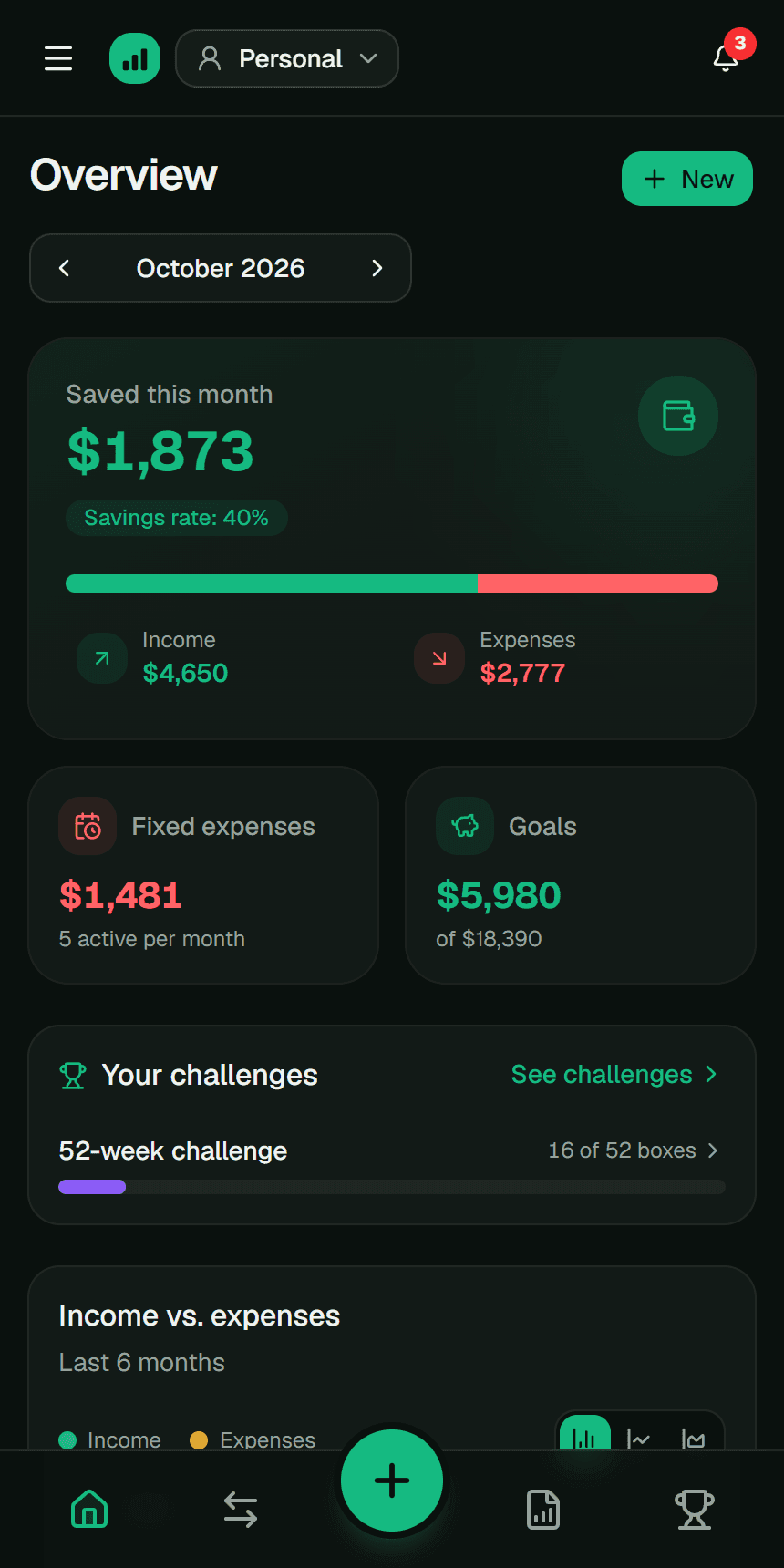
Build your budget in Fluvi
Unlimited income and expenses, by category and with charts: free. Fixed expenses with a reminder before they’re due: free for up to 3, unlimited on Premium.
Category limits with an alert when you get close, and PDF and Excel reports: Premium.
Frequently asked questions
How much should I save each month?
A common reference is 20% of income (the 50/30/20 rule), but if you can’t today, start with a fixed 5 or 10% and raise it little by little.
What if I go over one month?
See which category it was and make up for it next month. If it keeps happening, raise that limit and lower another: your budget has to look like your real life.
How often should I review my budget?
A quick look every week and a full review at the end of the month, comparing what you planned with what you actually spent.
How do we budget as a couple?
Add up your incomes, agree on shared expenses and leave some for each person’s own spending. With Fluvi Premium each of you can have a profile, with permissions, in the same finances.
Related guides
This guide is educational content, not personalized financial advice. The numbers are examples; adjust them to your situation. More details in the Terms and conditions (in Spanish).