How to close out your cash register, step by step
How to balance your cash at the end of the day, find shortages and stop them from happening again.
By the Fluvi team · Updated October 31, 2026
Cash register closing template
Start from the example and swap in your numbers, or clear it to print and fill in by hand.
1. What should be there
- Starting float$
- Cash sales$
- Cash payments on customer credit$
- Other cash you added$
- Expenses paid from the till$
- Cash taken out (to keep or deposit)$
Should be in the till$1,020
2. What you counted
- $100$200
- $50$300
- $20$360
- $10$80
- $5$45
- $2
- $1$30
You counted$1,015
3. Result
Short
$5
To keep or deposit
$865
What you need before closing
- The float: the cash you opened the day with.
- The day’s sales split by payment method. Only cash goes in the drawer.
- Receipts for what left the drawer: what you paid (a delivery, ice, a supplier) and what you took out to keep.
- A quiet moment to count, ideally with no customers waiting.
Balancing the till, with an example
A shop opens with a $150 float. During the day it makes $845 in cash sales, two customers pay $60 toward their credit and $35 is paid out of the drawer. At closing, the count is $1,015:
| Item | Amount |
|---|---|
| Starting float | + $150 |
| Cash sales | + $845 |
| Cash payments on customer credit | + $60 |
| Expenses paid from the drawer | − $35 |
| Should be there | $1,020 |
| You counted | $1,015 |
| Short | $5 |
You’re $5 short. It looks small, but a shortage like that every day adds up to $130 a month. That’s why it’s worth recording the difference every time, even when it’s small.
Card and transfer payments don’t go in the till
What customers pay by card, bank transfer or payment app goes to your account, not the drawer. Those sales are checked separately: make sure what you recorded matches what actually arrived. If you mix them with cash, the till will never balance.
If you’re over or short
- Count again, ideally someone else.
- Look for sales not recorded or recorded twice, and cash sales that were actually card payments.
- Check expenses paid from the drawer that weren’t written down.
- Think about change: giving too much is the most common cause of small shortages.
- Write down the difference with the date and who closed. If shortages keep happening on the same shift, you know where to look.
Good habits
- Always open with the same float and note how much you leave for the next day.
- If a lot of cash builds up during the day, take some out and record it as a withdrawal: less risk, and the count still balances.
- Do a blind count: whoever counts shouldn’t know how much should be there, so they count what’s really there.
- Don’t mix the business’s cash with your own.
- Keep every closing signed or on your phone: it’s your history to review later.
If you sell on credit, cash payments from customers go into the drawer too: see how to manage customer credit. And to know whether your monthly sales cover your costs, work out your break-even point.
Close out your register with Fluvi
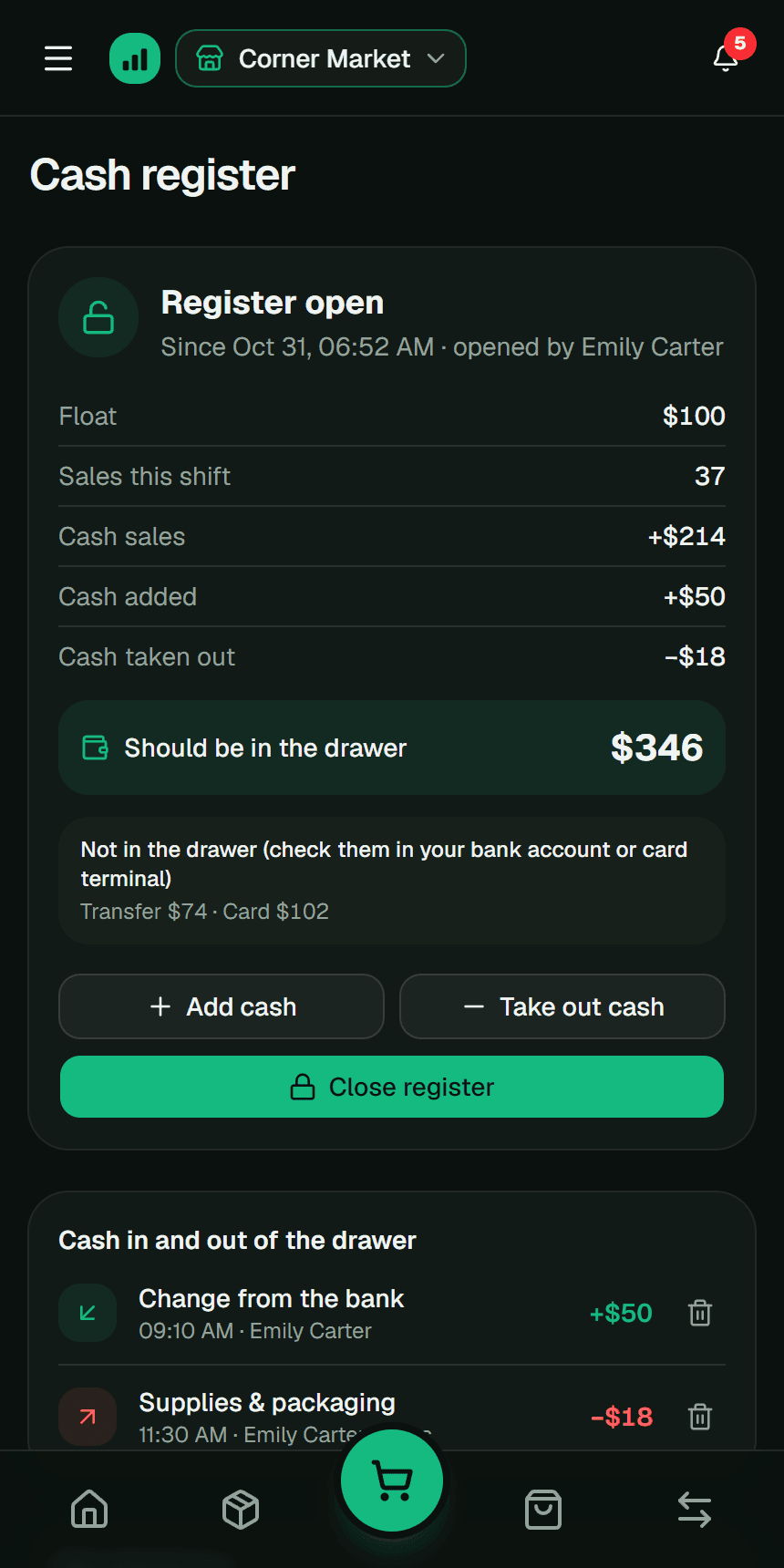
Open the shift with a float, cash sales and payments add up on their own, and at closing you count by bills: Fluvi tells you right away if the till balances, is over or short. Expenses you pay from the drawer are recorded as business expenses. It’s free.
With Premium you add employees: they count without seeing what should be there, and you see the difference on every closing.
Frequently asked questions
What is a cash float?
The cash you open with to give change: small bills and coins. It’s best to keep it the same amount every day and not count it as sales.
Is closing out the same as a cash count?
In practice yes: counting the cash and comparing it with what should be there. A surprise count in the middle of the day is a good way to check without waiting for closing.
How often should I close out?
At the end of every day or shift, especially if more than one person handles the register: that way every difference has a time and a person.
What do I do with an overage?
Don’t treat it as profit: it’s almost always an unrecorded sale or change given short. Write it down and look for it in the day’s sales.
Related guides
This guide is educational content, not personalized accounting or tax advice. The numbers are examples; adjust them to your business. More details in the Terms and conditions (in Spanish).