How to manage customer credit (tabs) without losing money
How to sell on credit without losing customers or money: limits, due dates, payments and collecting.
By the Fluvi team · Updated October 31, 2026
Customer credit notebook
One page per customer: write down each credit sale and payment and the balance adds up on its own. You can also print it blank.
- $Balance $38$
- $Balance $18$
- $Balance $30$
- $Balance $51$
- $Balance $21$
Total on credit
$71
Total paid
$50
Owes today
$21
$79 of credit left.
Why credit without control is expensive
Letting regulars run a tab helps you sell and keeps them coming back, but every sale on credit is stock you already paid for and money that hasn’t come in yet. Until they pay, you can’t use it to restock. And what isn’t written down gets forgotten: the customer doesn’t remember how much they owe, neither do you, and the argument ends up costing you both the money and the customer.
The rules for selling on credit
- Only extend credit to customers you know, who buy often and live or work nearby.
- Give each one a limit, based on how much they buy and how they’ve paid. Start low and raise it for those who pay on time.
- Agree on a due date (payday, end of the month) and write it down.
- Record each sale on credit right away: date, what they took and how much.
- Record each payment and the balance left, and show it to the customer.
- No more credit for anyone over their limit or with an overdue balance.
How to keep the record: one page per customer
A credit notebook works best with a page for each customer, like the template above: each line is a sale on credit or a payment, with the balance left after it. This is Linda Brown’s month, with a $100 limit:
| Date and item | On credit | Paid | Balance |
|---|---|---|---|
| Oct 3 · Rice, oil and eggs | $38 | $38 | |
| Oct 7 · Payment | $20 | $18 | |
| Oct 12 · Soda and bread | $12 | $30 | |
| Oct 15 · Milk and coffee | $21 | $51 | |
| Oct 20 · Payment | $30 | $21 | |
| Total | $71 | $50 | $21 |
Linda Brown owes $21 and has $79 of credit left. Payments reduce the total balance, not a specific purchase: what they pay covers the oldest first.
How to collect without losing the customer
- Remind them before the due date, not after: a message the day before feels like a favor, not a complaint.
- Collect in private and kindly, never in front of other customers.
- Send the balance in writing, for example by WhatsApp or text with what they took and what they’ve paid: it avoids arguments.
- Accept partial payments and record every one: a customer who pays a bit at a time is still a good customer.
Review your credit every week
Add up how much you’re owed in total and see who’s overdue. If that number keeps growing, you’re extending more credit than you collect: lower the limits or collect sooner. And a very old debt you won’t collect is a loss: take it off your books so you don’t count on money that isn’t coming.
Cash payments from customers go into the drawer: add them in your cash register closing. And before selling on credit, make sure the price leaves you a profit with the price and margin calculator.
Manage credit sales in Fluvi
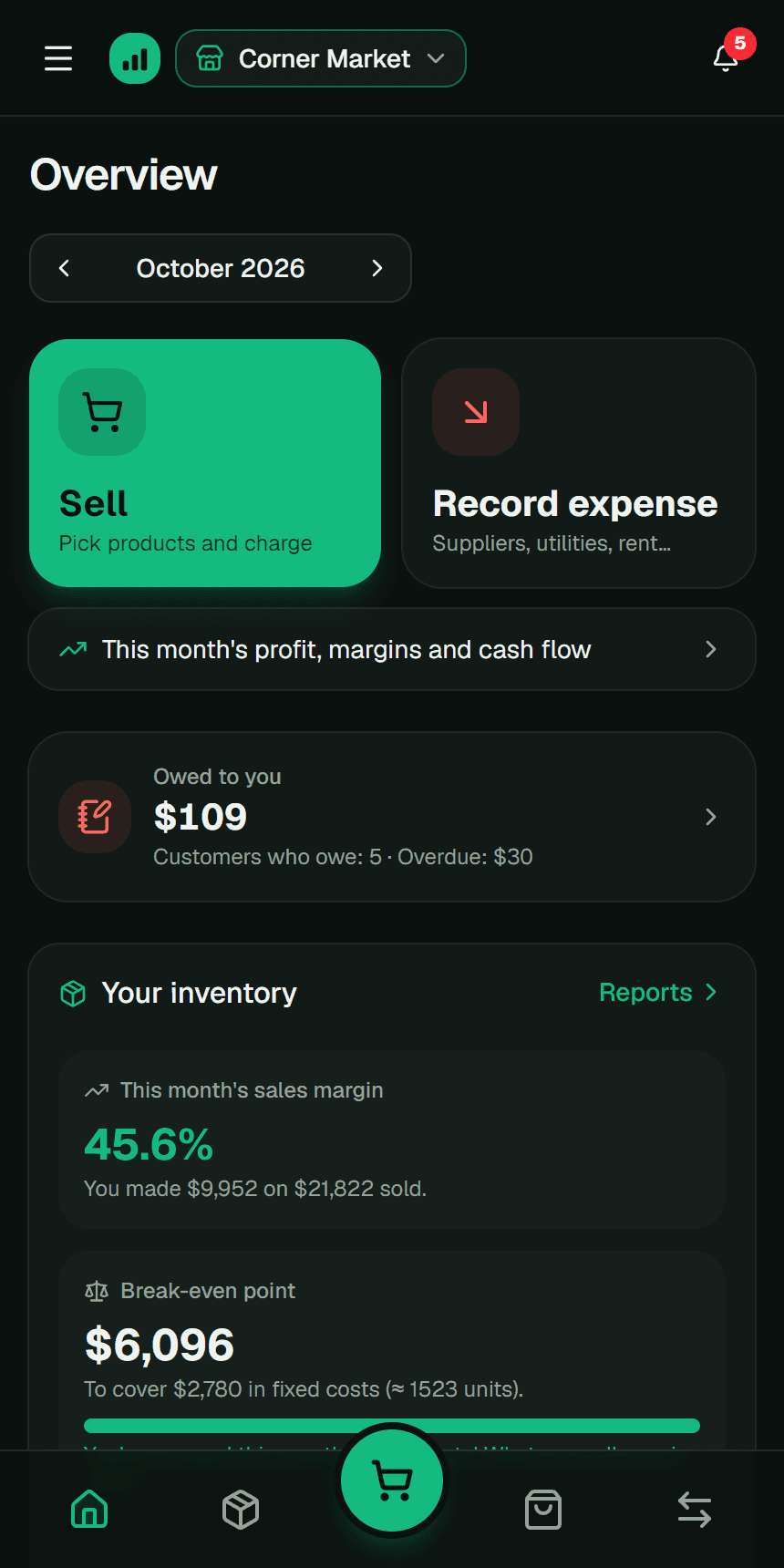
At checkout, choose On credit and the customer: Fluvi adds up their balance, records payments (cash ones go into the register) and lets you know when a credit sale is due. Send the customer what they owe on WhatsApp with one tap.
Free for up to 10 customers owing at the same time; with Premium, unlimited.
Frequently asked questions
Does a sale on credit count as a sale?
Yes: the day you sell on credit, you sell, and that sale has its profit. But the money comes in when the customer pays, so don’t count it in the till until they do.
How much credit should I extend in total?
What you can afford not to collect without running short for restocking and your fixed costs. If the total you’re owed grows month after month, you’re extending more than you collect.
What do I do if a customer doesn’t pay?
Stop extending credit, remind them kindly and offer to let them pay in installments. If they still don’t pay after a reasonable time, write it off so you don’t count on money that won’t arrive.
Is customer credit the same as accounts receivable?
Yes. In accounting, what your customers owe you is called accounts receivable. Healthy receivables are the ones you collect on time.
Related guides
This guide is educational content, not personalized accounting or tax advice. The numbers are examples; adjust them to your business. More details in the Terms and conditions (in Spanish).