Savings goal calculator: how much to save each month
Enter your goal and your deadline: see how much to set aside each month, how much you put in and how much interest adds.
By the Fluvi team · Updated November 7, 2026
Savings goal calculator
Enter your goal and what you already have, then choose whether you know the deadline or how much you can save a month.
Save each month
$733.32
That’s per week
$169.23
You put in
$9,799.84
Interest adds
$200.19
The formula, without interest
Monthly savings = (goal − what you have) ÷ months. It’s the right sum for most short-term goals, because over a few months interest changes little.
| Item | Value |
|---|---|
| Goal | $10,000 |
| Already saved | $1,000 |
| Still needed | $9,000 |
| Time | 12 months (1 year) |
| Monthly savings | $750 |
With interest: let your money work too
If you keep your savings somewhere that pays interest, you need a little less each month. In the example, at 4% APY you set aside $733.32 a month: you put in $9,799.84 and interest adds about $200.19. The calculator uses the effective annual rate (the APY most savings accounts show); if you only have a nominal rate, convert it with the compound interest calculator.
How long will it take?
Sometimes you don’t have a deadline but an amount that fits your budget. With $500 a month, starting from $1,000 and the same rate, you reach $10,000 in 18 months (1 year and 6 months) (ending with $10,315.46). Pick “How much I can save a month” in the calculator to run this one.
Typical goals and how much to set aside
| Goal | Amount | Time | Per month |
|---|---|---|---|
| Emergency fund (3 months of $2,500 expenses) | $7,500 | 18 months (1 year and 6 months) | $416.67 |
| Vacation | $3,000 | 10 months | $300 |
| Car down payment | $5,000 | 24 months (2 years) | $208.34 |
| New laptop | $1,200 | 6 months | $200 |
The emergency fund comes first: 3 to 6 months of your essential expenses, so a surprise doesn’t turn into debt.
How to hit your goal
- Save as soon as you get paid, not what’s left at the end of the month: there’s rarely anything left.
- Keep it separate, in another account, so you don’t spend it by accident.
- Automate it: a scheduled transfer on payday.
- If it’s hard to get going, try the 52-week savings challenge or split your paycheck with the 50/30/20 rule.
Track your goal in Fluvi
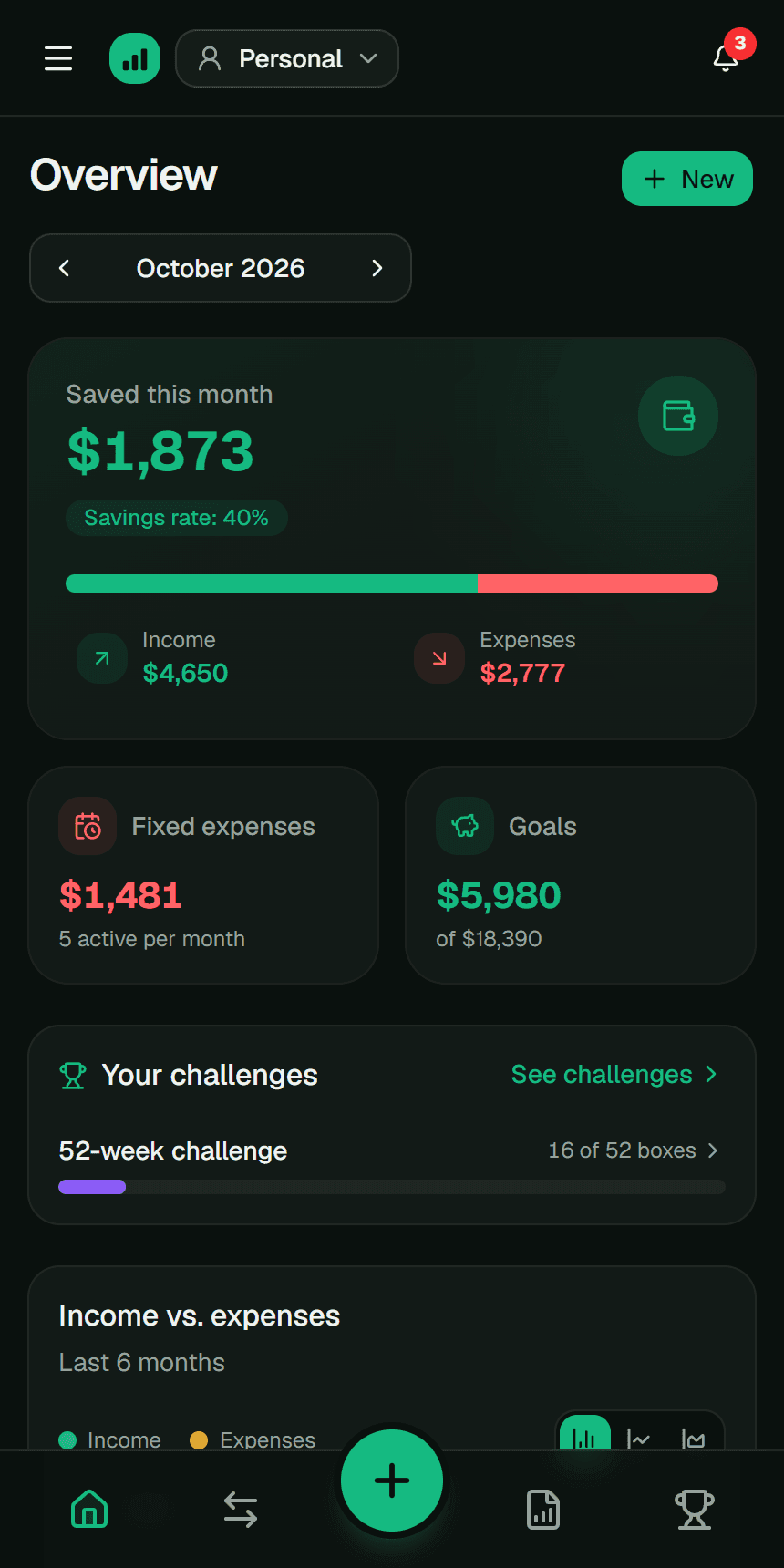
In Fluvi you create your goal with its amount and date, log each contribution and see how much you have and how much is left. And since you also track your spending, you know what’s left to save each month.
It’s free with up to 2 goals at a time; with Premium, unlimited goals and savings challenges.
Frequently asked questions
What rate should I enter if I don’t know what I earn?
Leave it at 0. The calculator then tells you what to set aside without counting on interest, which is the safest option. If you later keep the money in an account that pays, you’ll get there a little sooner.
What if the monthly amount is too much for me?
You have three levers: a longer deadline, a smaller goal, or starting with something you already have. Try “How much I can save a month” with what really fits your budget and see how long it takes.
Where should I keep the money for a goal?
Apart from your everyday account, so you don’t spend it without noticing. For short-term goals a savings account or a deposit you can withdraw in time works well; avoid risking money you’ll need in a few months.
Does inflation change my goal?
Yes. If the goal is to buy something a year or more from now, it will probably cost more. Add what you think the price will rise to your goal, or review it every few months.
Related guides
This guide is educational content, not personalized financial advice. The numbers are examples; adjust them to your situation. More details in the Terms and conditions (in Spanish).