Compound interest calculator: how much your money grows
See how much your money grows when interest earns interest too, with what you add each month.
By the Fluvi team · Updated November 7, 2026
Compound interest calculator
What you have today, what you add each month, the yearly return and for how many years.
You’ll have in 10 years
$36,177.50
You put in
$25,000
Interest earned
$11,177.50
31% of what you’ll have is interest. At that rate your money doubles in about 10.2 years.
| Year | Contributed | Interest | Balance |
|---|---|---|---|
| 1 | $3,400 | $146.06 | $3,546.06 |
| 2 | $5,800 | $470.34 | $6,270.34 |
| 3 | $8,200 | $985.33 | $9,185.33 |
| 4 | $10,600 | $1,704.36 | $12,304.36 |
| 5 | $13,000 | $2,641.72 | $15,641.72 |
| 6 | $15,400 | $3,812.70 | $19,212.70 |
| 7 | $17,800 | $5,233.65 | $23,033.65 |
| 8 | $20,200 | $6,922.07 | $27,122.07 |
| 9 | $22,600 | $8,896.67 | $31,496.67 |
| 10 | $25,000 | $11,177.50 | $36,177.50 |
What compound interest is
With simple interest you always earn on the same amount. With compound interest, each period’s interest is added to the balance and the next period earns on it too. The gap is small at first but grows every year:
| Year | Simple interest (10%) | Compound interest (10%) |
|---|---|---|
| 1 | $1,100 | $1,100 |
| 2 | $1,200 | $1,210 |
| 3 | $1,300 | $1,331 |
| 4 | $1,400 | $1,464.10 |
| 5 | $1,500 | $1,610.51 |
The formula
For a starting amount P, a monthly deposit D, a monthly rate i and n months: future value = P × (1 + i)n + D × ((1 + i)n − 1) ÷ i. The calculator starts from the effective annual rate (APY), converts it to monthly ((1 + rate)1/12 − 1) and assumes each deposit is made at the end of the month.
Time matters more than the rate
With the same deposit and rate as the example, see what happens if you leave it longer:
| Years | You put in | Interest | You’ll have |
|---|---|---|---|
| 10 | $25,000 | $11,177.50 | $36,177.50 |
| 20 | $49,000 | $56,376.96 | $105,376.96 |
| 30 | $73,000 | $168,502.78 | $241,502.78 |
After 10 years interest is 31% of what you have; after 30, it’s most of it. Starting ten years earlier is usually worth more than finding a slightly better rate.
The rule of 72
To see how many years it takes to double your money, divide 72 by the yearly rate. At 7%, 72 ÷ 7 = 10.3 years (the exact figure is 10.2). Handy for quick sums without a calculator.
Account for inflation
If your savings earn 7% and inflation is 3%, your buying power grows by about 3.9% a year, not 7%: (1.07 ÷ 1.03) − 1. For long-term goals, enter your return minus inflation in the calculator to see the figures in today’s money.
Beware of promises of high returns
Compound interest is slow and boring, and that’s how it should be. If someone promises high, “guaranteed” monthly returns, be suspicious: that’s the classic shape of Ponzi schemes and scams. Before investing, check the firm is regulated by your country’s financial authority. To start with the basics, give your savings a goal.
Track your deposits in Fluvi
Compound interest starts with consistency. In Fluvi you create a savings goal, log each deposit and watch it grow month by month, alongside your spending and income.
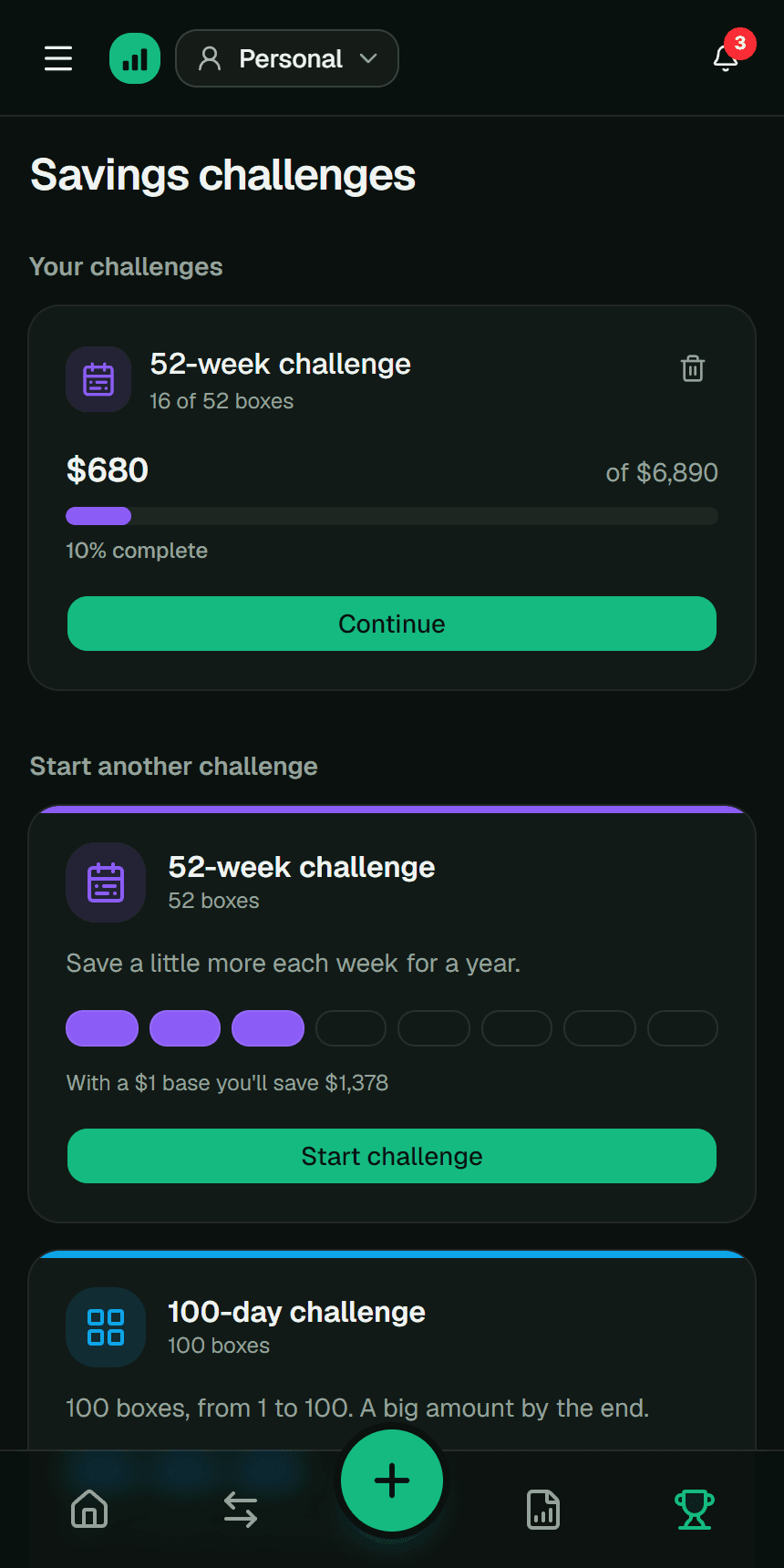
It’s free to start; with Premium, unlimited goals and savings challenges with boxes to tick.
Frequently asked questions
What rate should I enter?
What your savings or investment really earns per year, as an effective annual rate (APY). If you don’t know, try a conservative one: a pleasant surprise beats a nasty one.
My bank quotes an APR compounded monthly. How do I convert it?
Divide the APR by 12, add 1, raise it to the 12th power and subtract 1. For example, 12% compounded monthly is 12.68% APY.
Does the result include taxes and fees?
No. Management fees and taxes on returns reduce what you keep. Take them off the rate for a more realistic figure.
Is a higher rate or more time better?
Both help, but time weighs the most: compound interest grows each year on a bigger base. That’s why it pays to start early, even with a little.
Related guides
This guide is educational content, not personalized financial advice. The numbers are examples; adjust them to your situation. More details in the Terms and conditions (in Spanish).